An unglamorous part of building AI Agents in 2026 is that a lot of the models are essentially interchangeable. In most cases, swapping GPT for Claude for Gemini doesn’t produce a huge difference in the end product. The moat that startups and innovators have is the data the agent is accessing. It's the terabytes of stored data that differentiate them from each other.
The issue is structural and doesn’t seem to be going away anytime soon. Frontier model context windows hold a few megabytes of text at most, while inference data measures in terabytes. No context window will be able to catch up to the scale, meaning the winners will be determined by data quality and how well models retrieve it.
It's not an easy problem to solve. Data changes constantly, datasets are large so latency for retrievals can be long, and your agent needs to be correct. If you can solve data, the agent will feel omniscient. If you fail on data, you will be burning GPU power on an expensive agent apologizing that it can't find the information you're looking for.
So how do agents connect to massive datasets today? In practice, nearly every architecture converges on a few patterns, each with a distinct strong suit, and each with a failure mode that shows up exactly when agents start doing real work.
Why AI Agents Need External Data
AI agents need external knowledge for a variety of reasons: knowledge becomes outdated, context windows are finite, and enterprise data often lives outside the model.
Knowledge becomes stale fast. Current events unfold, the cutting edge shifts, and even "evergreen" facts change as companies ship updates, policies evolve, and internal docs drift out of sync with the model's knowledge cutoff.
Most valuable enterprise knowledge is proprietary and siloed: customer records, product telemetry, support tickets, Slack threads, and internal runbooks rarely exist in public training data, and they're often permissioned in ways a model can't access by default.
Finally, agents need grounding to be reliable. External retrieval lets an agent cite the exact source of truth it used (the policy page, the row in the database, the latest incident report), reducing hallucinations and making outputs auditable, debuggable, and safe to act on.
The Ways Agents Connect Today
Behind the scenes, almost all agents connect to their data sources in a few ways, each with its own pros and cons, depending on the agent's use case.
Pattern 1: API and Tool Calling
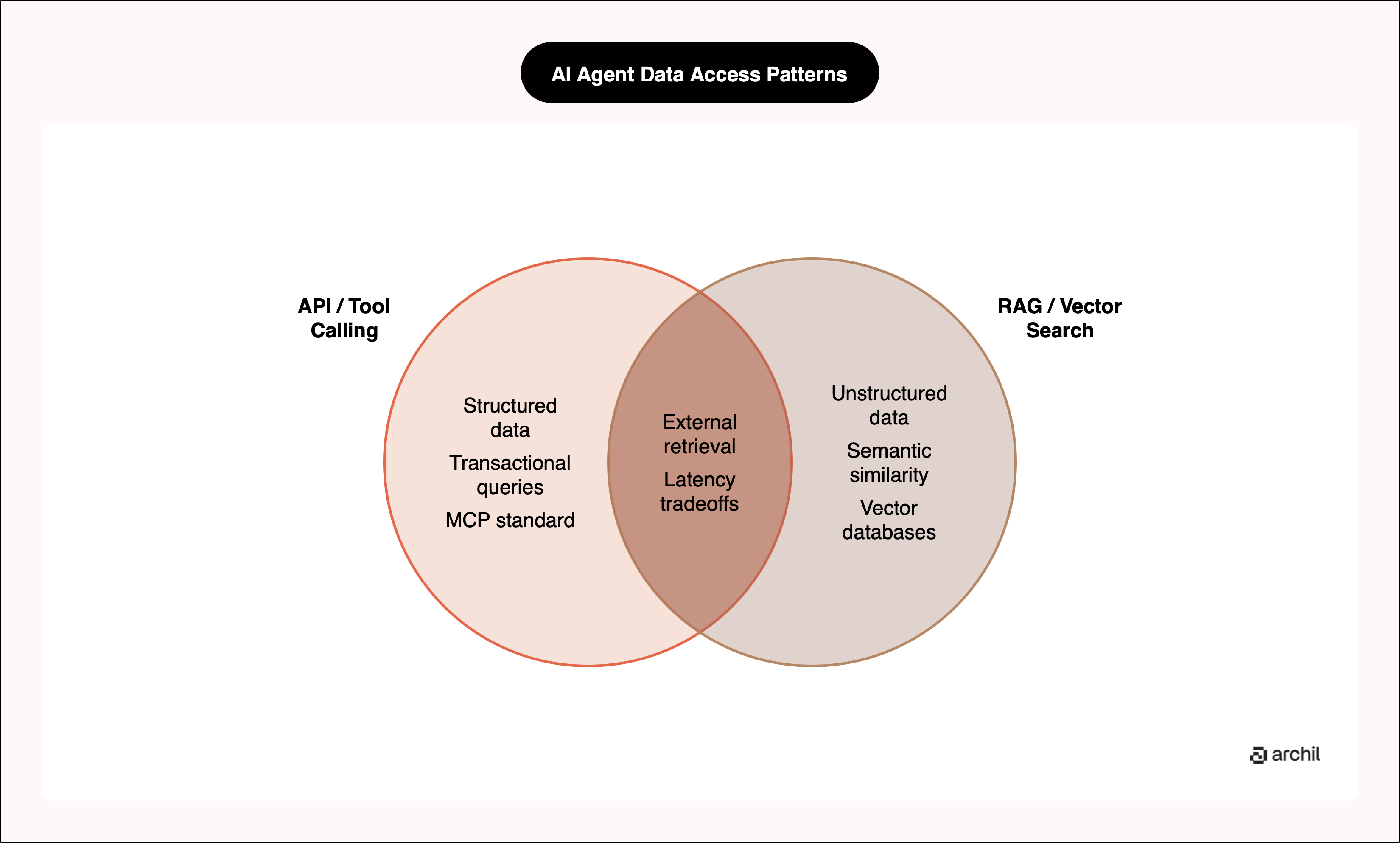
The most direct approach is to give the agent the ability to query data sources on demand through an API — a pattern called tool calling. A typical use case is a customer service agent querying a customer's order information. Model Context Protocol (MCP) has standardized it to make this configuration short and easy for most use cases.
This is great for structured and transactional data, where the agent can pinpoint what it needs and quickly access it. The agent knows exactly what it wants and retrieves it quickly. The failure mode is scale and data shape. Every retrieval is an API call, and chaining calls increases latency and wastes tokens simultaneously. APIs return answers, not data, so if you know exactly what you want, this is great for your agent. Otherwise, another retrieval method may work better.
Pattern 2: RAG and vector retrieval
If data is unstructured, like most data is, the standard approach is retrieval-augmented generation, or RAG. Chunk the corpus, embed the chunks, store the vectors in a vector database, and at query time pull the top-k most semantically similar pieces into context. It's the most mature pattern on this list, with an entire industry of vector databases and embedding pipelines behind it.
RAG finds data based on the semantic meaning of the query, which is useful when the answer spans a sentence buried across 10,000 documents. RAG identifies relevant chunks and surfaces them for the agent to reason over. However, a major failure point of RAG is keeping data current. Chunking can also produce incomplete responses. What if the chunk of a python function removes one or two of the imports? What if you’re analyzing data and it only returns 6% of the CSV? RAG helps the agent look for information, but often falls short of giving the agent everything it needs.
Why agents break the old paradigm
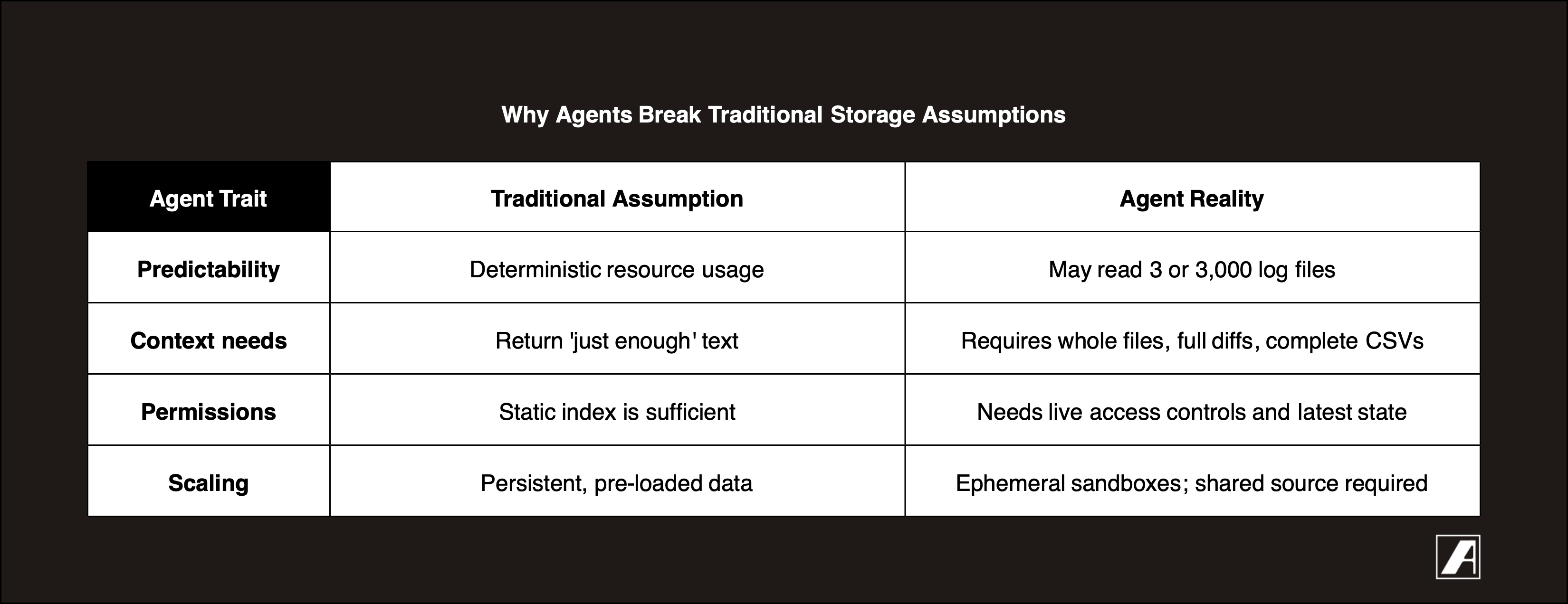
While this has helped solve many agent problems, it is hard to treat AI Agent storage as just another workload. RAG is good for chatbots, data warehouses for analysts, and APIs for apps. Agents are inherently different for a few reasons.
Agents are unpredictable: Most non-AI workflows are predictable; the resources they need and their plan of action are deterministic. For AI agents that’s not the case: it might read three log files or three thousand; it might suddenly need a checkpoint from last month or one image out of a corpus of ten million.
Agents need full context, not excerpts: Most retrieval systems were designed to return “just enough” text to answer a question. Agents often need whole artifacts to do real work — the entire pull request diff, the full CSV, the complete policy doc, or a whole function plus its imports. Partial chunks are fine for Q&A, but they break when the agent is asked to edit, compute, refactor, or execute multi-step tasks.
Agents operate in permissioned, changing environments: Enterprise data is gated by roles, row-level permissions, and constantly changing state (new tickets, updated docs, evolving schemas). An agent can’t rely on a static index; it needs retrieval that respects access controls, reflects the latest truth, and can explain where each fact came from when something goes wrong.
Agents scale horizontally and ephemerally: Scaling agents up means scaling compute up, and scaling down means cutting compute. The problem is that data is not persistent and must be loaded each time, increasing cold-start latency. Reading from one shared source would be ideal, but existing shared sources either don't scale to fleets or don't expose the interface agents' tools expect.
Agents require a different data access paradigm than conventional software, driven by their unpredictability and non-determinism. Retrieving the wrong data produces frustrated users and broken workflows.
The cloud filesystem: mount the data, don't move it
The idea isn't new: expose an object storage bucket as a local directory so that open() and read() work against objects directly. s3fs has done this for well over a decade, and AWS ships its own version in Mountpoint for S3.
The drawback is that it is still object storage behind the scenes, even if the interface changed. You still get the same latency, the same HTTP round-trip per action, and the same API costs. That may be acceptable for humans or software where throughput is predetermined, but AI agents introduce far more unpredictability.
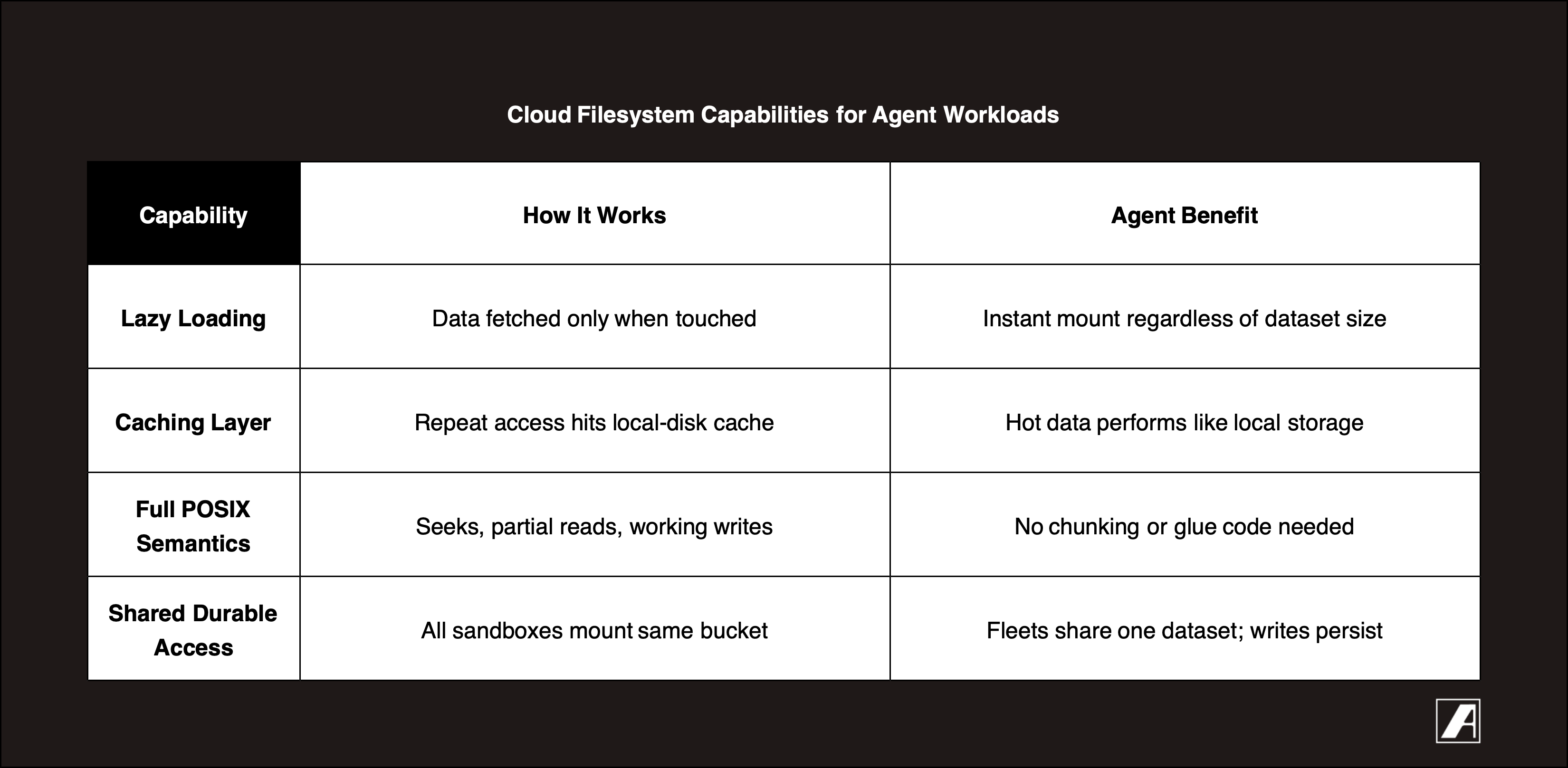
The newer generation of the cloud filesystem keeps the mount model but adds a caching and consistency layer between the agents and the bucket. That addition lets it meet the requirements outlined earlier:
- Lazy loading. Mounting is instant regardless of dataset size; data moves only when touched. The agent that reads three log files pulls three log files.
- Caching. First access fetches from S3; repeated access hits the cache at local-disk latency. Since agents tend to revisit the same working set, the hot path soon performs like local storage.
- Full POSIX semantics. Tools see whole files with seeks, partial reads, and working writes. No chunks, no glue code.
- Shared, durable access. Many sandboxes mount the same data and see a consistent view, so fleets share one dataset instead of copying it per worker. Writes persist back to object storage, so outputs outlive the sandbox.
Taken together, these properties close the gap the earlier patterns left open: object storage keeps its scale and economics, while agents finally get the local-disk speed and full-file semantics their tools expect.
Where Archil fits
Archil is this pattern as a product: a cloud filesystem that mounts S3 as local storage, built for AI workloads: training data, model weights, and agent sandboxes. A fleet of agents can each mount the same object storage bucket in milliseconds, read hot data at local-disk speed through Archil's caching layer, and write results back durably without any sync code.
The larger shift is the takeaway. Agents didn't just need more storage, they changed what the layer underneath has to do. Question-shaped work will keep running through APIs, warehouses, and RAG. But for file-shaped work, the approach that's winning is the simplest one: don't move the data to the agents, mount it. If you're building agents that need to touch real files at real scale, visit archil.com.